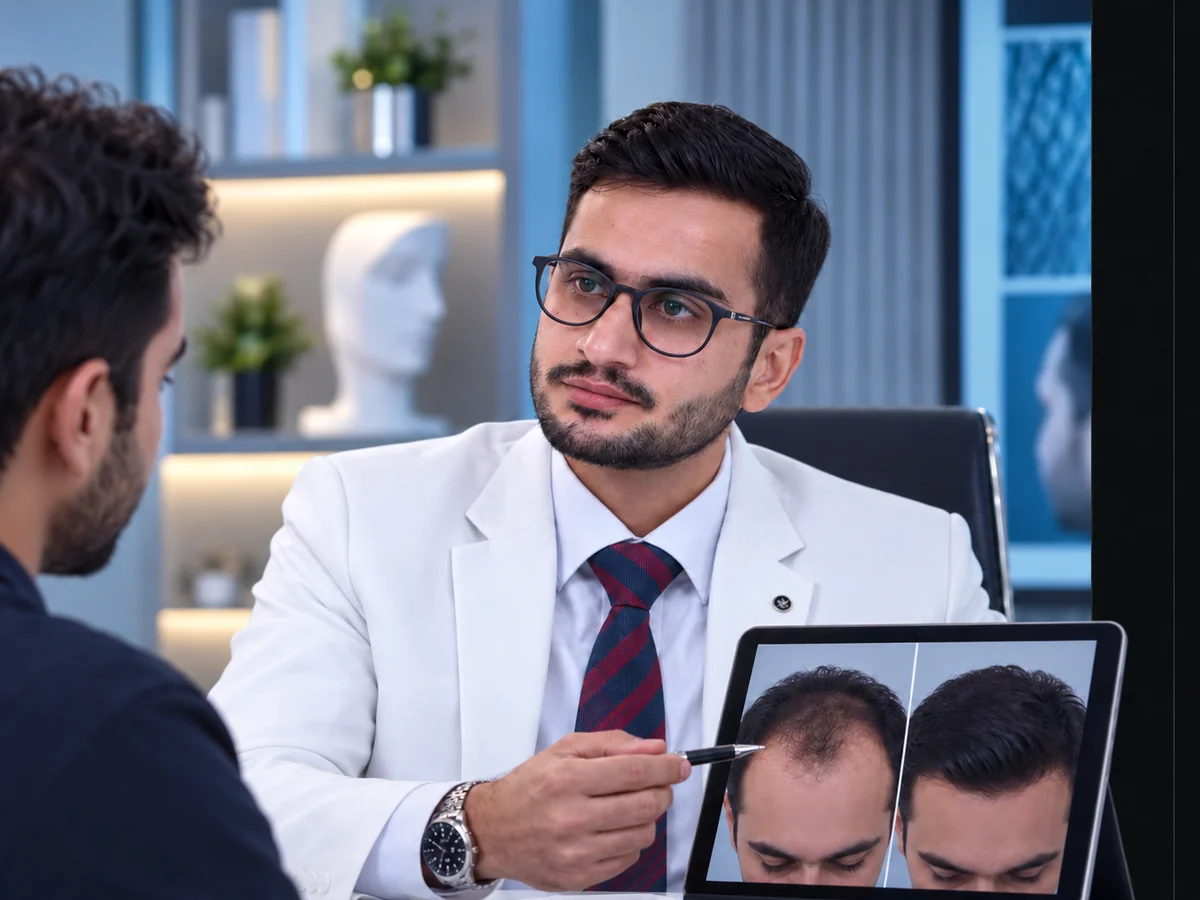
Best Hair Transplant in Lahore? Surgeon-Led FUE with Dr Hammad Saleem
Dr Muhammad Hammad Saleem personally performs FUE hair transplantation, with clinical team support where appropriate. Standard scalp-donor FUE is PKR 120,000 flat. The hairline, graft requirement and donor plan are confirmed after examining your donor area and the area to be restored. Consultations and procedures take place in Model Town, Lahore. For the detailed fee structure, graft-based reference and mega-session pricing, see the Hair Transplant Cost in Lahore guide.
Standard scalp-donor FUE PKR 120,000 flatMaximum suitable grafts planned after donor assessment
Individual graft planningDonor assessment firstGraft count and coverage priorities are confirmed after examination
Planning focus Donor preservation
Graft planning is based on donor strength, coverage goals and preserving the donor area's long-term density and appearance.
Surgeon credentials
FUE personally performed by a certified hair transplant surgeon.
Dr Hammad Saleem is a certified plastic surgeon and certified hair transplant surgeon in Lahore. He is registered with PM&DC. He personally assesses the donor area, plans the hairline and performs FUE extraction, recipient-site creation and graft placement, with clinical team support where appropriate.
Professional registration PM&DC-registered plastic surgeon
Dr Hammad's professional registration and plastic-surgery qualification have been confirmed by the clinic.
Plastic surgery Certified Plastic Surgeon
His broader practice includes plastic, reconstructive and aesthetic surgery as well as hair restoration.
Dr Hammad personally performs FUE hair transplantation rather than handing the surgical procedure over to an unnamed operator.
Procedure responsibility Personally performs FUE
Donor assessment, hairline planning, extraction, recipient-site creation and graft placement are performed by Dr Hammad, with clinical team support where appropriate.
At Dr Hammad Aesthetic, FUE is the only hair-transplant method we perform. Dr Hammad personally carries out the procedure, while planning graft extraction and placement around your donor area, hairline and coverage goals. Read about Dr Hammad's qualifications and broader plastic-surgery practice.
Our method FUE only
We perform Follicular Unit Extraction for our hair-transplant procedures.
Anaesthesia Local anaesthesia
We normally perform FUE under local anaesthesia and explain the process before treatment.
Donor area Assessed before planning
We check donor density, hair characteristics and previous procedures before estimating grafts.
Hairline Designed for your face
We plan hairline position, direction and coverage around your available donor supply.
FUE cost How much does an FUE Hair Transplant cost in Lahore?
Standard scalp-donor FUE is PKR 120,000 flat. The graft count follows your donor assessment, with a PKR 40–70 per-graft reference. Mega sessions requiring additional donor harvesting have additional charges.
Graft planning How many grafts do I need for an FUE Hair Transplant?
For FUE Hair Transplant, we calculate grafts after checking your recipient area, donor density, hair characteristics, hairline goals and future hair-loss pattern.
Why FUE How does an FUE Hair Transplant work?
FUE lets us harvest individual grafts without a long linear strip scar and gives us precise control over donor-area planning.
Recovery When can I return to work, wash my hair or exercise after an FUE Hair Transplant?
For FUE Hair Transplant, we give you clear aftercare instructions based on your procedure, healing and daily routine.
Growth When will transplanted hair grow after an FUE Hair Transplant?
For FUE Hair Transplant, growth develops gradually. We explain the expected shedding and growth phases during consultation and follow-up.
Consultation What happens during an FUE Hair Transplant consultation?
We examine your donor area, hair-loss pattern and goals, then discuss graft planning, expected coverage and your final FUE price.
Dr Hammad explains
Watch Dr Hammad explain FUE Hair Transplant.
Watch the official Dr Hammad Aesthetic video here without leaving the treatment page.
Dr Hammad explains the fee
Why is standard FUE PKR 120,000 flat?
Hear Dr Hammad explain the flat standard FUE fee, how donor capacity guides graft planning, and when a larger mega-session plan may carry additional charges.
FUE hair transplant cost in Lahore
Standard scalp-donor FUE is PKR 120,000 flat.
Standard scalp-donor FUE is PKR 120,000 flat, and the graft number is confirmed after donor and recipient-area assessment. Larger mega-session plans that require an additional donor source are assessed separately. For the PKR 40–70 per-graft reference, mega-session pricing and a fuller explanation, read the Hair Transplant Cost in Lahore guide.
Standard scalp-donor FUEPKR 120,000 flat
Your graft count is confirmed after examination and planned around your donor area, the area to be restored and long-term donor preservation.
Graft count is individualConfirmed after donor and recipient-area assessment rather than from a fixed graft package.
Detailed pricing guideSee the dedicated cost guide for the PKR 40–70 per-graft reference and how the flat fee is explained.
Mega sessions are separateIf an additional donor source is required for a larger plan, the extra scope and fee are confirmed after assessment.
Coverage is prioritisedHairline, frontal area, mid-scalp and crown priorities are discussed according to your available donor supply and goals.
Graft planning
“How many grafts?” needs more than a baldness grade.
A photograph or baldness grade cannot confirm the final graft number. Dr Hammad examines the recipient area, donor density, hair characteristics and long-term hair-loss pattern before finalising the plan. For a detailed guide to the factors that affect graft requirements, see How Many Hair Grafts Do I Need?. For donor density, previous harvesting and donor preservation, read the Hair Transplant Donor Area Guide.
Frontal hairline & forelock
Mid-scalp
Crown / vertex
This diagram shows the main areas we assess when planning your FUE transplant. Your actual graft count is confirmed after examination.
01 • Recipient area We assess the area you want to restore
We look at the frontal hairline, mid-scalp and crown separately so we can plan where your available grafts will make the strongest visual difference.
02 • Donor density We check your donor density
We examine donor density, follicular-unit distribution and any previous harvesting before deciding how many grafts to plan for your procedure.
03 • Hair characteristics We consider your hair characteristics
Hair calibre, curl, colour contrast and the number of hairs within each follicular unit can all affect how much visual coverage a graft plan can create.
04 • Long-term plan We plan for the long term
We design your hairline and donor plan with future hair loss in mind so the result remains balanced as your native hair changes over time.
Candidacy
Who may be suitable — and who needs a different plan.
We assess your hair-loss pattern, donor density, scalp condition, age, previous treatment and goals before recommending FUE. Suitability depends on whether transplantation can create useful coverage with a realistic donor plan and long-term strategy.
Potentially suitable FUE may suit you if
✓Usable donor density at the back or sides of the scalp.
✓A hair-loss pattern that can reasonably be treated with transplantation.
✓Realistic goals for density, hairline and the limits of donor supply.
✓Willingness to follow donor and recipient-area aftercare.
Individual assessment We may recommend a different plan if
!Poor or limited donor density, especially after previous over-harvesting.
!Active scalp disease, scarring hair loss or an uncertain diagnosis that needs evaluation first.
!Rapidly progressing loss where future planning is especially important.
!Expectations that exceed what the available donor area can safely provide.
Hair restoration options
FUE, PRP or Hair Exosomes — which treatment does what?
These treatments are used for different hair-loss situations. FUE moves your own follicles into areas where you need new coverage; PRP and Hair Exosomes are separate non-surgical options for selected patients with existing hair. If you are still deciding which pathway to discuss, start with our Hair Transplant, PRP and Exosomes comparison guide.
01 • Hair transplant
FUE Hair Transplant
For patients who need new hair coverage in bald or significantly thinned areas and have a suitable donor area.
During FUE, we remove individual follicular units from the donor area and transplant them into the areas where you want more coverage. Your graft count, hairline design and treatment plan are decided after examining your donor density and pattern of hair loss.
Creates new coverage by transplanting your own donor follicles.Hairline, direction and graft distribution are planned individually.Standard scalp-donor FUE: PKR 120,000 flat; PKR 40–70 per-graft reference. Mega sessions are priced separately.
Your exact FUE plan depends on your graft requirement and donor area. We explain each stage before treatment so you know what to expect from assessment through aftercare.
01
Assessment
We review your hair-loss pattern, donor strength, medical history and goals before confirming your treatment plan.
02
Hairline & graft plan
We design your hairline and agree the areas to prioritise, then estimate a graft range around your donor supply.
03
Donor extraction
We harvest individual follicular units from the donor area using small punches.
04
Recipient sites
We create recipient sites according to your planned direction, distribution and hairline design.
05
Placement & aftercare
We place the grafts and give you clear instructions for protecting both the donor and recipient areas.
Recovery & growth
Healing is early. Hair growth is gradual.
Recovery happens in stages: early scalp healing comes first, temporary shedding can happen, and new hair growth develops gradually over the following months.
Early recovery Protect the grafts
We give you clear instructions for washing, sleeping, medicines and protecting the grafts during early recovery.
First days / weeks Redness & crusting can occur
Some redness, crusting, swelling or tenderness can occur early on. We explain what is expected and when to contact us.
Following weeks Temporary shedding can occur
Some transplanted hairs may shed before new growth begins. We explain this phase so it does not come as a surprise.
Following months Growth develops over time
New growth develops gradually and continues to mature over time. Your timeline can vary depending on your individual case.
Your donor area guides your hairline and graft plan.
During your consultation, we assess your hair-loss pattern, donor strength, previous treatment and preferred hairline. We then discuss your expected graft range, coverage, recovery and FUE price before you decide on treatment.
FUE Hair Transplant Results — before & after examples.
These Hair Transplant before-and-after examples show different patterns of hair restoration. Your own result depends on donor supply, hair-loss pattern, graft planning, hair characteristics and the time allowed for growth.
33 clinic-supplied comparison imagesTap or click any image to view it larger.
Hair Transplant Result 01 Existing caseRear-view Hair Transplant comparison showing change in scalp coverage.Hair Transplant Result 02 Existing caseFrontal Hair Transplant comparison showing change in visible hair coverage.Hair Transplant Result 03 Existing caseFrontal Hair Transplant comparison showing change in visible hair coverage.
More FUE cases30 optimized clinic images
FUE Hair Transplant Case 04 FUEClinic-supplied before-and-after comparison.FUE Hair Transplant Case 05 FUEClinic-supplied before-and-after comparison.FUE Hair Transplant Case 06 FUEClinic-supplied before-and-after comparison.FUE Hair Transplant Case 07 FUEClinic-supplied before-and-after comparison.FUE Hair Transplant Case 08 FUEClinic-supplied before-and-after comparison.FUE Hair Transplant Case 09 FUEClinic-supplied before-and-after comparison.FUE Hair Transplant Case 10 FUEClinic-supplied before-and-after comparison.FUE Hair Transplant Case 11 FUEClinic-supplied before-and-after comparison.FUE Hair Transplant Case 12 FUEClinic-supplied before-and-after comparison.FUE Hair Transplant Case 13 FUEClinic-supplied before-and-after comparison.FUE Hair Transplant Case 14 FUEClinic-supplied before-and-after comparison.FUE Hair Transplant Case 15 FUEClinic-supplied before-and-after comparison.FUE Hair Transplant Case 16 FUEClinic-supplied before-and-after comparison.FUE Hair Transplant Case 17 FUEClinic-supplied before-and-after comparison.FUE Hair Transplant Case 18 FUEClinic-supplied before-and-after comparison.FUE Hair Transplant Case 19 FUEClinic-supplied before-and-after comparison.FUE Hair Transplant Case 20 FUEClinic-supplied before-and-after comparison.FUE Hair Transplant Case 21 FUEClinic-supplied before-and-after comparison.FUE Hair Transplant Case 22 FUEClinic-supplied before-and-after comparison.FUE Hair Transplant Case 23 FUEClinic-supplied before-and-after comparison.FUE Hair Transplant Case 24 FUEClinic-supplied before-and-after comparison.FUE Hair Transplant Case 25 FUEClinic-supplied before-and-after comparison.FUE Hair Transplant Case 26 FUEClinic-supplied before-and-after comparison.FUE Hair Transplant Case 27 FUEClinic-supplied before-and-after comparison.FUE Hair Transplant Case 28 FUEClinic-supplied before-and-after comparison.FUE Hair Transplant Case 29 FUEClinic-supplied before-and-after comparison.FUE Hair Transplant Case 30 FUEClinic-supplied before-and-after comparison.FUE Hair Transplant Case 31 FUEClinic-supplied before-and-after comparison.FUE Hair Transplant Case 32 FUEClinic-supplied before-and-after comparison.FUE Hair Transplant Case 33 FUEClinic-supplied before-and-after comparison.
Individual results vary. Hair loss pattern, donor supply, graft requirement, hair characteristics and follow-up time can change the visible outcome. Case-specific graft counts or timelines are only added when they are documented.
FUE gallery
Standard scalp-donor FUE at Dr Hammad Aesthetic is PKR 120,000 flat. The graft number is confirmed after donor and recipient-area assessment. Larger mega-session plans that use an additional donor source are priced separately. See the Hair Transplant Cost in Lahore guide for the detailed fee structure.
A mega session is a larger hair-transplant plan in which the standard scalp donor area may not be the only donor source used. If additional graft harvesting is planned, such as from the beard or submandibular area, the procedure has additional charges. The exact mega-session plan and fee are confirmed after assessment.
For FUE Hair Transplant, we calculate your graft requirement after examining your donor density, recipient area, hair calibre, hairline goals, crown involvement and previous treatment. A photograph can give an early idea, but the final graft count is confirmed after assessment. Dr Hammad aims to plan the maximum suitable scalp-donor grafts for your case while preserving the donor area's long-term density and appearance.
For FUE Hair Transplant, the individual follicular units we remove do not simply grow back in the same extraction spots. We therefore spread extraction carefully across your donor area so the remaining hair maintains a balanced appearance. This is why we assess donor density before deciding how many grafts to use.
At Dr Hammad Aesthetic, we perform FUE hair transplantation. FUE describes the individual extraction of follicular units from the donor area. DHI commonly refers to an implantation method rather than a completely different donor-harvesting method. Our focus is FUE donor planning, natural hairline design and careful graft placement.
We perform FUE rather than FUT at Dr Hammad Aesthetic. With FUE, we remove follicular units individually, so there is no long linear strip scar from removing a strip of scalp. We plan the extraction pattern around your donor density and the coverage you want to achieve.
You may be suitable for FUE if you have a usable donor area, a hair-loss pattern that can be treated with transplantation and realistic coverage goals. During consultation, we also review your age, scalp condition, medical history, previous treatment and the way your hair loss may progress before recommending a plan.
Yes, some women can be good candidates for FUE. We first look at the cause and pattern of hair loss and make sure the donor area is strong enough for transplantation. If thinning is very diffuse or another condition needs attention first, we will explain that during assessment before planning grafts.
At Dr Hammad Aesthetic, the minimum age for a hair transplant is 23 years. We still assess the pattern and stability of your hair loss, donor strength, family history and long-term goals before recommending FUE, because age alone does not determine the final treatment plan.
FUE avoids the long linear strip scar associated with FUT. Because we remove individual follicles with small punches, tiny dot-like marks can remain in the donor area, but they are usually distributed among the surrounding hair. We plan extraction carefully according to your donor density and hairstyle.
We normally perform FUE under local anaesthesia. You may feel the anaesthetic injections and some pressure or discomfort during parts of the procedure, and mild soreness can occur during recovery. We explain the anaesthesia and aftercare plan before treatment so you know what to expect.
For FUE Hair Transplant, shaving depends on your graft requirement, donor area, hair length and the way we plan your procedure. Some cases need more trimming than others. If keeping your existing hair length is important to you, tell us during consultation so we can explain what is practical for your case.
The time needed for FUE depends mainly on your graft requirement and treatment plan. A smaller session and a large multi-thousand-graft session will not take the same amount of time. After we assess your donor and recipient areas, we can give you a more useful estimate for your procedure day.
For FUE Hair Transplant, your return to work depends on the type of work you do and how your scalp looks and feels during early healing. Desk work and physically demanding work may need different timelines. We give you a personalised return-to-work and activity plan before you leave the clinic.
We give you specific washing instructions after your FUE procedure. Early graft care is important, so we explain when and how to wet, cleanse and dry the donor and recipient areas without unnecessary rubbing. Follow the instructions we give you rather than a generic routine from the internet.
For FUE Hair Transplant, a cap should not press or rub against newly placed grafts. We will tell you when loose headwear is appropriate based on your recovery and the type of cap you want to wear. If you need a cap for work, travel or privacy, mention it before treatment so we can guide you properly.
We give you an activity plan after FUE based on your healing and the intensity of your exercise. Early vigorous exercise can increase sweating and friction around the treated scalp, so gym training, swimming, heavy lifting and contact sport are usually reintroduced gradually according to your recovery.
Temporary shedding of transplanted hair can happen after FUE and does not automatically mean the transplant has failed. The visible hair shafts can shed while the follicles remain in the scalp and later enter a new growth cycle. We explain this phase during aftercare so you know what to expect.
FUE growth develops gradually rather than immediately. Early healing happens first, and some transplanted hairs can shed before new growth becomes visible over the following months. Density and texture continue to mature with time, and we explain the expected stages during your consultation and follow-up.
Transplanted follicles can continue to grow for the long term, but FUE does not stop future thinning in your non-transplanted hair. We therefore plan your hairline and donor use with future hair loss in mind and may discuss ongoing hair-loss management when it is relevant to your case.
Yes, some people may choose a second FUE procedure later if native hair loss progresses, the first treatment was intentionally staged or they want additional coverage. Before using more grafts, we reassess your remaining donor density and decide whether another procedure is worthwhile.
Your donor area is the foundation of your FUE plan. We assess density, hair characteristics and any previous extraction so we can distribute graft removal properly and preserve a balanced donor area and future reserve. The assessment confirms your graft count and whether the standard scalp-donor plan is appropriate or a larger mega-session plan needs to be discussed.
We give you written and verbal aftercare instructions after FUE. Contact us if your recovery feels different from what we explained, if discomfort or swelling is getting worse rather than better, or if you are unsure about washing, medicines, sleeping position, exercise or the appearance of the donor or recipient area.
For FUE Hair Transplant, if you still have existing hair and your main concern is hair fall or thinning rather than creating new coverage in a bald area, a non-surgical option may be more relevant. We can assess whether Hair PRP or Hair Exosomes fits your hair-loss pattern and treatment goal. FUE is different because it physically moves donor follicles into areas where new coverage is needed.
They may be discussed as separate non-surgical treatments depending on your hair-loss pattern, existing hair and treatment goals. They do not replace the graft placement of FUE. If they are relevant to your case, you can read more about Hair PRP treatment and Hair Exosomes before your consultation.
For FUE Hair Transplant, choose a clinic that examines your donor area carefully, explains who performs each step, designs a realistic hairline and gives you a clear graft and price plan before treatment. The doctor should also explain what can realistically be achieved with your donor supply and how future hair loss may affect the long-term plan. Use our guide to checking your hair-transplant surgeon and procedure team before you decide.
Dr Muhammad Hammad Saleem, a certified plastic surgeon and certified hair transplant surgeon registered with PM&DC, personally performs the FUE hair transplant, with clinical team support where appropriate. He assesses your donor area, plans the hairline and graft requirement, and performs the extraction, recipient-site creation and graft placement. Read his surgeon profile and qualifications before your consultation.
You can review FUE Hair Transplant before-and-after examples in the Hair Transplant Results section on this page. These are individual patient examples, and results vary from person to person.